Tuesday, March 27, 2018

Temporary Captivity Is Important

(p.91/p.92 Steal Like An Artist by Austin Kleon)
It's been awhile since I made my last blog post with spring break and all.

Re-reading chapter seven was a reminder of how Austin's words fascinate and inspire me. At one moment he'll stress how important it is to do one thing, and then on the next page talk about how equally important it is to do the opposite. It's almost paradoxical. But, as complicated humans we are, he's right in saying that we need both contradictory things in our lives. 

For example, this chapter was about learning how to be happy in solitude: making the most out of it, giving yourself time for it, etc. Then, he told us to get out of our comfortable little world “Your brain gets too comfortable in your everyday surroundings.” he states on page 94, and encourages us to take a trip. Go to the next town over, the next state over, the next country over. Get your mind in an unfamiliar space because it makes the world look new. In a creative aspect, that unleashes thoughts and ideas that you would never have imagined if you hadn't forced yourself into a new perspective.

On page 96, Kleon mentions that being around interesting people helps motivate creative thinking. I completely agree with that. The people I love most in the world also happen to be the most interesting. Artists and chefs, photographers, foreigners, musicians, stamp collectors, manga readers, hippies, theater nerds and movie lovers. The list goes on and on. They are the people that get me into new environments, the people that make me envious of their talents and make me want to try harder to become better than them. They are the people who force me to play catch-up and inspire my most creative ideas. 

Onto another topic, here is a review of Sharpie Art Workshop: Techniques and Ideas for Transforming Your World by Timothy Goodman. While the people featured were all pretty successful and rightfully featured (I even went so far as to do a little more research on a few of them) and the images eye-catching, I found the writing of book to read like big Sharpie ad. It wasn't compelling and didn't have any solid content. He goes through the colors available in each pen, defines what a post-it note is, lists the colors of those too and even references Wikipedia (unfortunately, I've been guilty of this). It was a book that had so much potential, but besides being pretty to look at, was a big disappointment for me.

That's all for this week. Thanks for reading.

— B

Tuesday, March 13, 2018

Do Good Work & Share It

This weeks chapter of Austin Kleon's Steal Like An Artist was all about doing work and sharing it with others. He starts by giving you advice to take advantage of where you're at in your life. Maybe you're still in college; take advantage of how much attention your work has for the time being and take what you can out of it. Maybe you're out of college and on your way to starting your career; take advantage of your obscurity. Use that time to create whatever the hell you want because there are no consequences. When you start asking yourself "How do I become known?" that's when you start sharing your work with the world. Post online; One-up the person doing the same thing; Keep searching for the thing no one is paying attention to and make it the next trend. 

All in all, do good work and share it.

I like a lot of the advice Kleon gives us. It gives me a newfound appreciation for being so unknown right now and also motivates me to keep sharing the good work that I do, no matter how nerve-wracking it can be.

Near the end of the chapter, he says that the Internet can be an incubator for ideas that aren't fully formed, and that's right after writing that people go to the Internet to find something to say. I think an interpretation of this could be: the Internet is a good place to go to find other people who are passionate about the same things as you, but it's also a place to find new things that you're passionate about. Everyday millions of new topics, images, videos, ideas, and news gets circulated for people to find. For you to find. So, in a way the Internet is the place to go to find the topics that you didn't even know you cared about yet and to expose us to ideas that we didn't know we were thinking about.

At some points, Kleon feels that having a public online presence can be a kick in the pants. By this he means that because of how websites and blogs are set-up, online visitors that go to your domain are always going to see your latest post first. In Kleon's words "You're only as good as your last post." which is true. If you aren't trying to one-up yourself every time, you run the risk of losing viewers. The truth is, if people don't find your page interesting, then it's not worth their time to scroll through your blog until they get to the interesting part. There's not enough time in the day and with today's fast, fast, fast approach to everything, people just don't have the attention span. But by pushing yourself a little harder than your previous effort, you get to improve just a little more.

To start sharing my work and thoughts that don't usually leave my head, I've started a new blog. You can find it here.

That's all for this week.

— B

Tuesday, March 6, 2018

One Day It'll All Make Sense

Chapter 5 of Austin Kleon's Steal Like An Artist, appropriately named "Side project and hobbies are important." is about just that: explaining that people, creative people especially, need time to do other things besides work. They need time to do nothing. Kleon mentions that he never goes to the dry cleaners for this reason, he finds the boring and repetitive action of ironing great for stimulating ideas. I can't help but agree with this practice.


Boring work can be incredibly helpful because more than likely people are going to be thinking about what they'd rather be doing.

The things I do when doing nothing usually consist of cleaning my room, unloading the dishwasher, cleaning the cat box, and other various house chores. Lucky for me, I have a lot of free time at my place of work, inspiration doesn't come easier when avoiding actual work. (I promise I'm a great employee.)

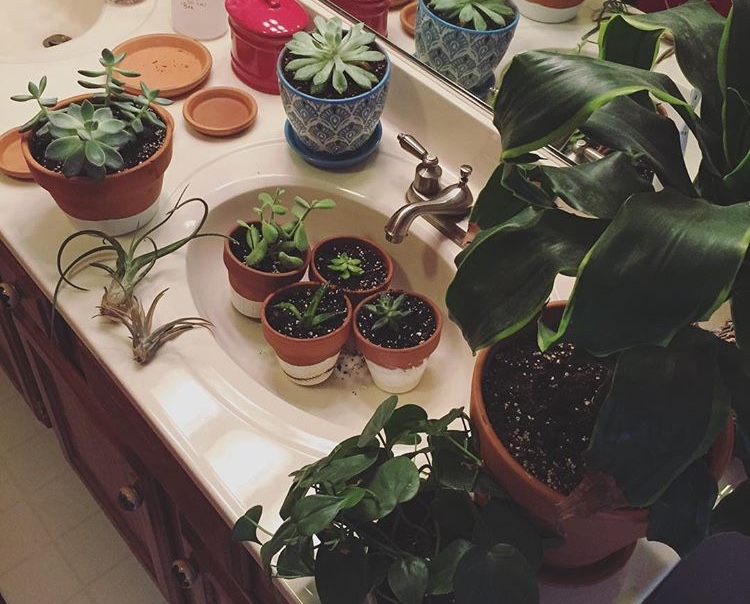
My many plants alive at the moment.
Another key point in this chapter, mentioned in the chapter title, is having a hobby. "Don't throw any of yourself away." Hobbies are a part of your identity. What else could be said about the things you actually want to pour your time into? It's the part of your day just for you. Where you don't have to worry about a deadline or the happiness of a client. You do it for you and everyone needs that. Not only does it regenerate your creativity, but it shines through in your work.

My hobbies are vast and I do it on purpose. I try to introduce myself to as much as I can. Some things stick and others don't but at least I can say I've tried it. Right now I love to paint abstract, cook, I do photography, I keep a minimum of six plants alive at a time, read and write, of course I play video games, I run (yeah, like the exercise), I like to fix things, and I love, love, love collecting. There's three major collections I've had for years now. Coffee Mugs. Sweaters. And notebooks/sketchbooks.

That's all for this week.

— B

Tuesday, February 27, 2018

Art That Only Comes From The Head Isn't Any Good


(page 56, Steal Like An Artist)
This week, Austin Kleon gives us even more priceless advice. He tells us to get out of our office chairs with the sunken cushion and into a different space where we can stand up and create something with our own two hands.

I've always loved working with my hands. I love to create projects that yield results I can touch, like sculptures or collages or paintings. I think as designers it's important to get that knowledge of how things stick together, cut and bend. Basically of how things work. It lets you see your work differently compared to someone who's only worked on the computer and expands your mind to what you know you can do.

In chapter four, Austin Kleon asks us to create a space away from technology, an analog space. I set mine up on my kitchen table and told myself to make a poster. Honestly I had no clue what kind of poster I was going to make, all I knew was that I had glue, I had an xacto knife, and I had my imagination.

My analog space
Generating ideas this way was so liberating. You can get so stuck on one concept if you start from the computer, and be unwilling to change decisions you've made. Doing things with my own hands meant making mistakes, and because I couldn't easily press ctrl+z, I had to make the mistake work. I was constantly making changes and when I did that generated a whole new line of ideas. Plus looking at a computer screen waiting for ideas to come to you isn't the most inspiring, don't you agree?

In the end this is what I made and I'm ok with that. Sure if I had done this on the computer it would probably look better and I wouldn't be stuck with all this glue on my fingers... but if I'd done it on the computer I don't think this piece would exist.

Now, I'm going to go back to sipping on water and hopefully fight off this stomach bug.

That's all for this week.

— B


Tuesday, February 20, 2018

We Like Art

This week, re-reading chapter three of Austin Kleon's book, Steal Like An Artist, I was greeted with the familiar headline of "Write What You Know Like".

To sum up this chapter, Kleon shares with us the disappointment he felt when his favorite movie's sequel wasn't as good as the one he cooked up from his own imagination. He puts into words the feeling that I think all of us creatives have felt at one point or another; the feeling that things would have been better if we were the ones in charge of it.

I loved reading this chapter because I could relate to it as one fan fiction writer to another. I played the most recent release of my favorite game series and was crushed when the story didn't live up to my expectations.

top: Teresa Sdralevich | bottom left: Bruno Munari
bottom middle: Alvin Lustig | bottom right: Sister Corita Kent
A few months later I'm writing down my own version of the story.

So, basically, create what you like and write the story you want to read.

If I applied that manifesto to my life, like Kleon suggests, I would re-write it like this: I would expose myself to more art and music and whatever the hell else I want much early on. I would try more things and not stay inside so much. I would make more meaningful connections to my peers and neighbors and involve myself in the community. I wouldn't be afraid to put my true self out into the world.

Taking that into account, I would want the next few years to be something like this: finish my degree, visit more museums, get a job I like, continue what I'm passionate about, travel lots, keep finding new hobbies, create all the time, learn everything I can about anything, eat good food, and as cliche as it is, just lead a happy life. Someone once told me that they considered themselves to be a selfish person because they lived how they wanted. Though I wouldn't consider it being selfish, I think we should all take a page from their book and do more things for ourselves every once in while.

Brooke Armstrong
On page 48, Kleon suggests an exercise: “If all your favorite makers got together and collaborated, what would they make with you leading the crew?”

For this exercise, I made a poster for a book called The Curious Incident of the Dog in the Night-Time by Mark Haddon. The title quotes the Sherlock Holmes short "Silver Blaze" and, spoilers, the dog dies. I took a lot of my inspiration from my main mentor Teresa Sdralevich. Her illustrations have a quirky and child-like essence to them, but uses that to address serious situations, and her type style ranges from hand-written to Swiss/International. Her and my other mentors commonly use a minimal color palette and a lot of simple shapes and graphics.

I took the knowledge that I absorbed from my mentors and incorporated it into my own work. I've got a long way to go to even compare my style to theirs, but for something that I made in one night, I don't think it's too shabby.

That's all for this week.

— B

Tuesday, February 13, 2018

"Even The Beatles Started as a Cover Band"

Chapter 2, Steal Like An Artist
Chapter two of "Steal Like An Artist" by Austin Kleon features advice that defines the line of stealing and copying, imitating and emulating.

"We learn to write by copying down the alphabet. Musicians learn to play by practicing scales. Painters learn to paint by reproducing masterpieces." (page 35, Steal Like An Artist)

Nobody knows what style they'll develop which is why I like this quote so much.

When you learn to write as a child you start by copying letters. Our lines aren't straight and the words are barely legible. Once we learn, though, we aren't looking at the alphabet for reference anymore, we know how to do it, and thus our own style starts to come through. Over time our handwriting is as apart of ourselves as our personality. Maybe it's a curly cursive, or maybe it looks as illegible as when you started but you took something done thousands of times before and made it your own.

This is a key point that Kleon tries to get across, (though his explanation is much more elegant) you copy at first to learn the mechanics behind it, and then you take what you learned and transform it into something all your own. Or in other words: emulation.

The good artist emulates. The bad artist imitates.

Left: Teresa Sdralevich | Right: Brooke Armstrong
Above I've done a quick exercise of tying to emulate a piece by my mentor, Teresa Sdralevich. I tried to encapsulate her childlike imagery with her use of light colors. I translated the original text and used it for my emulation.

That's all for this week. Thanks for reading.

— B

Monday, February 5, 2018

I Just Want to Drink My Coffee in Peace

I usually enjoy writing and sharing, as it has always been a way for me to relax and take my mind off of things, but this week, I'm not really feeling myself. Luckily for you that means less to read.

Let's carry on.

I went to the library and found ten books that I thought might be interesting to read. They say not to judge a book by it's cover, but that's more or less exactly what I did. Continuing with Austin Kleon's advice, he says to always be reading, so I plan on buying one of these and I'll get back to you with my opinion on it.


Something else Kleon recommends, taking a quote from John Waters, is having an unread library. I actually have quite a few books I haven't gotten around to reading yet (I promise your day will come) and keep a wish-list on my Amazon account to add to said collection. Naturally, most of them are design books to fuel my passion even more.
The others are manga.


The newest one to this collection is Poster Power, which was suggested to me by Teresa Sdralevich herself. As soon as I get my next paycheck it's going in the check-out cart. A few of these were sourced from Kleon's recommended reading list. It's a little humorous... when I finished the book for the first time I saw the list and bought the first two right after. My plan was to check off each one I finished until I read them all. Now it turns out we're required to read one for class anyways, so I guess that worked out for me.

The first one I finished was Ignore Everybody by Hugh MacLeod. It wasn't very long and had a lot of great advice (don't ever let me borrow a book because I love to write all over it). He shared his own experiences of being a "starving artist" in New York and proved that keeping a balance between a boring life and a creative one is the key to staying sane. I think it's a great book that any type of artist should read as alot of what he says is worth remembering.

I'll keep this post short and simple and leave it at that.
Now, I'm going to finish my coffee.

— B
 
Designed by Beautifully Chaotic